
Amazon FBA prep requirements come down to one rule: every unit must arrive correctly labeled, packaged, and protected — or Amazon can reject it, return it at your cost, or dispose of it. Now that Amazon has ended its own prep service, meeting these requirements is entirely on you or your prep partner. This is the complete 2026 compliance checklist, from FNSKU labels to pallets.
1. FNSKU labeling
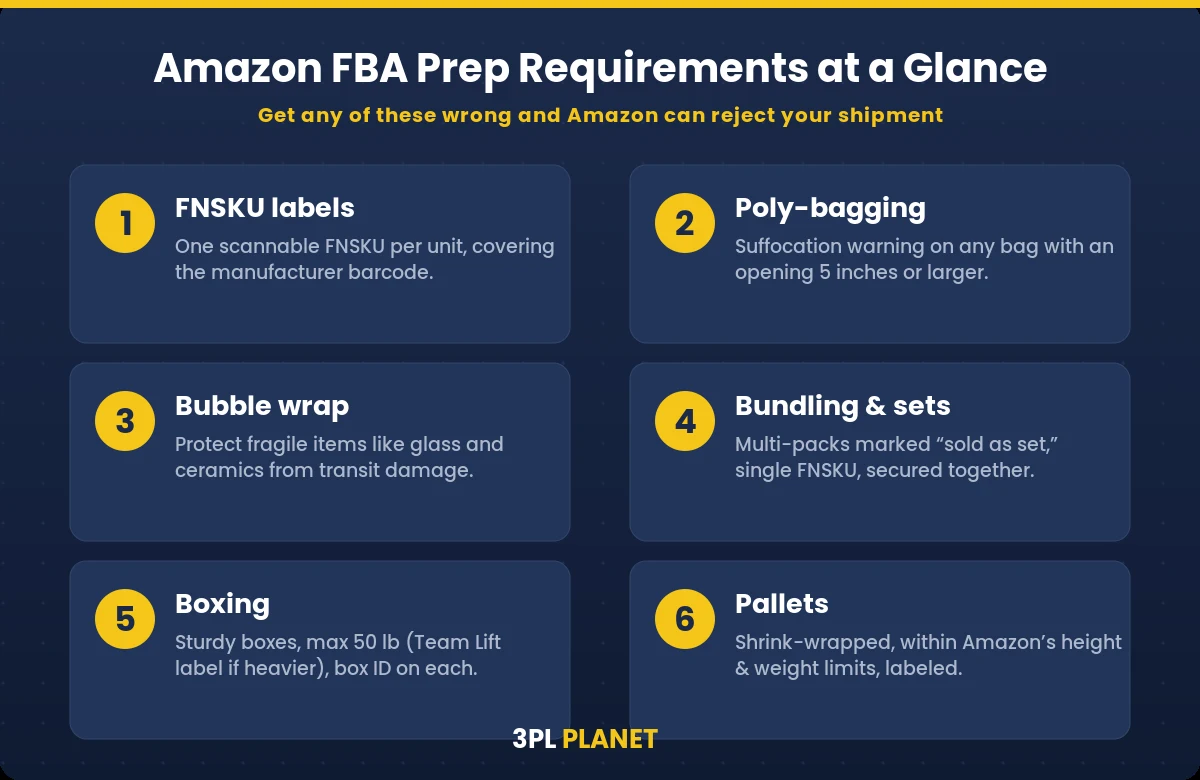
Every unit needs a single, scannable FNSKU label that identifies it to Amazon. The label must fully cover the manufacturer's original barcode — if two scannable barcodes are visible, the item can be miscounted or refused. Labels should be printed clearly (thermal or laser), placed on a flat surface, and never wrap around edges where they can't be scanned.
2. Poly-bagging & suffocation warnings
Loose soft goods, apparel, and items that could be damaged by dust or moisture must be poly-bagged. Any bag with an opening of 5 inches or larger must carry a suffocation warning label. The bag should be transparent, sealed, and the FNSKU must be scannable through or on the bag.
3. Bubble wrap & fragile protection
Fragile products — glass, ceramics, electronics — need enough protection to survive Amazon's fulfillment network. Bubble wrap or dunnage should prevent movement inside the box. Under-protected fragile items are a leading cause of damage claims and negative reviews.
4. Bundling & sets
Multi-packs and bundles must be clearly marked as sold together — a "Sold as set, do not separate" sticker — and carry a single FNSKU for the whole bundle, not one per component. Components should be secured together (taped, bagged, or shrink-wrapped) so they can't come apart in transit.
5. Boxing requirements
Your shipping boxes have their own rules:
- Use sturdy, undamaged boxes — no thin or previously crushed cartons.
- Keep each box under 50 lb; anything heavier needs a "Team Lift" label (and over ~100 lb, "Mechanical Lift").
- Apply a unique box ID / shipment label to every box, flat and scannable.
- Don't mix a single box across multiple shipment IDs.
6. Pallet requirements (LTL/FTL)
If you're shipping by pallet, they must be shrink-wrapped, stacked within Amazon's height and weight limits, and carry valid pallet and shipment labels on all sides. Overhanging boxes, unstable stacks, or missing labels can get an entire delivery turned away at the dock.
The most common rejection reasons
Most rejected shipments come down to a short list:
- Missing or unscannable FNSKU labels.
- Visible manufacturer barcode not covered.
- Missing suffocation warnings on poly-bags.
- Overweight boxes without the correct lift label.
- Bundles without a "sold as set" marking.
How a prep center keeps you compliant
A dedicated prep center does this all day, every day. At 3PL Planet, we receive and inspect your inventory, apply FNSKU labels, poly-bag and bubble-wrap where needed, build compliant bundles, box and palletize to Amazon's current spec, and ship it out — with an under-1% error rate that protects your account. You get compliant shipments accepted on arrival, without learning every rule yourself. Explore our FBA prep service or bundling & labeling to see exactly what's included.
Let us handle Amazon compliance for you
Prep from $0.35/unit, no setup fees — plus 20% off your first prep.
Get a Free Quote